From Painted Backdrops to Pocket Cameras: A Short History of Amateur Filmmaking
History of amateur filmmaking, from painted sets and 8mm reels to home video and phones, shows how each tool changed what makers could record and share.
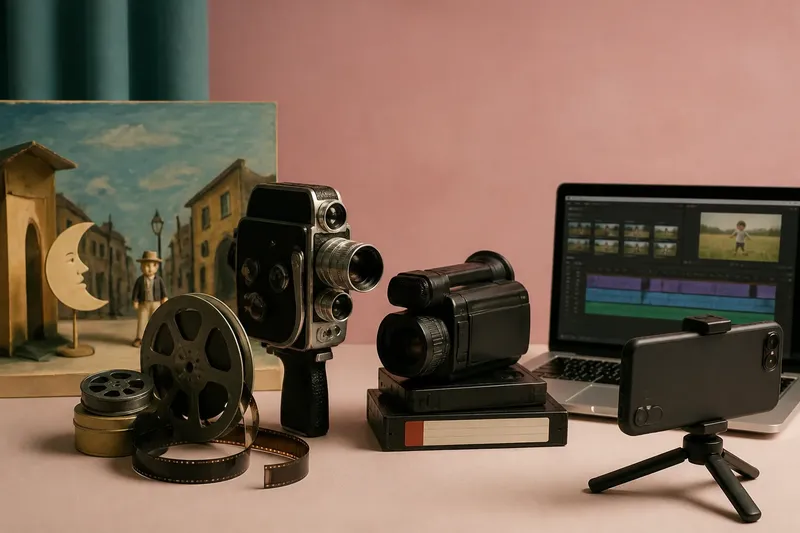
History of amateur filmmaking can be read through the objects that brought moving images into ordinary homes: a camera loaded with 8mm film, a projector in a darkened room, a video recorder beside the television, and later a phone in a pocket. Each tool changed not only how a picture was captured, but what a beginner could readily stage, review and show.
Fixed cameras and theatrical staging shaped early home films
Before compact cameras became common, making a film at home often meant arranging a scene for a stationary camera. Borrowed theatrical habits suited that setup: a painted cloth, a table and a few props could turn a room into an imagined street or palace without asking performers to travel.
The frame behaved like a small stage. Actors could enter from one side, pause for a gag or reveal a prop, while the camera stayed put. A cardboard moon did not need to look real; it needed to read clearly against the backdrop.
That approach is visible in many early amateur films, where staged sketches sit alongside records of family occasions. The distinction matters: the home camera was both a way to preserve events and a means of putting on a performance for relatives.
8mm and Super 8 made family subjects practical to film
Small-gauge formats such as 8mm and Super 8 helped bring motion-picture making into more homes. Their compact film and cameras suited subjects such as holidays, birthdays and short staged scenes, though making a film still involved physical stock and a projector for viewing it.
Film made every recorded moment tangible: a maker had to load the camera and decide what to point it at, then wait for the material to be processed before seeing the result. That delayed feedback encouraged planning, but it also meant that a missed gesture could not simply be checked on the camera screen.
Imagine a beginner using a Super 8 camera to film a toy train on a kitchen table. They place the camera low, arrange the track so the train stays in view, and let it cross the frame; the resulting short scene makes the train’s journey legible through position and movement, not elaborate effects.
Home video replaced the wait with immediate playback
Consumer video formats, including VHS-C and Video8, shifted home recording from exposed film to magnetic tape. A camcorder connected recording and playback to a television, so a maker could review a moment soon after filming rather than wait for film processing.
That change made it easier to notice a face slipping out of frame or a line lost beneath room noise, then try again. It also suited domestic scenes built around speech and small reactions: a pause at the dinner table could matter as much as a carefully staged entrance.
Tape brought its own routines. A maker might rewind to find a passage, keep track of which recording sat on which cassette, or copy footage between devices. The screen became a place to learn from the recording, not just to watch a finished film.
Desktop editing turned the computer into a cutting room
As personal computers gained video-editing software, home filmmakers could assemble recorded clips on a timeline. Instead of physically cutting a strip of film, they could move a shot, trim a pause or add a title, then review how the sequence played.
Non-linear editing also made it easier to compare different orders. A close-up placed before a wide view can change what the viewer expects; a cut made after an action can leave its result hanging in the air. The interface offered new choices, but the footage still had to supply the meaning.
Say a beginner has recorded a friend opening a mysterious box, with one wide view and one close-up of the lid. They import both clips, place the wide view first, then cut to the close-up as the hands reach the clasp; playback reveals whether the action remains easy to follow, and if the cut hides the reach, they can move it later or keep the wider shot.
Phones made the camera part of everyday life
Digital compact cameras and smartphones brought capture and playback into the same portable device. A short idea could be filmed between other tasks and reviewed on the spot, rather than requiring a dedicated camera, film stock or a separate editing room.
That portability changed the kinds of moments beginners could collect. A phone might be ready for a passing cloud shadow or a quick kitchen scene, but convenience does not decide where the viewer should look. A bright window can compete with a face, and a hand near the microphone can muffle a line.
Before recording, choose where the camera will sit and what must remain visible. A shelf or phone clamp can steady a frame; playback through headphones can make distracting room sounds easier to notice.
Digital sharing changed who could see a home film
Digital files made it possible to copy a film and send it beyond the household without arranging a projector screening. Online platforms opened further ways to show a short animation, a local portrait or a family scene to people who were not in the room when it was made.
That convenience also brought audience and privacy choices into the process. Before uploading, consider who appears in the footage, whether they are comfortable with the intended audience, and whether a private link or public post fits the material. For questions involving a child’s privacy or consent, use careful judgement and seek appropriate guidance where needed.
Sharing can influence form, too. A film shown on a small screen may need its subject and situation to read quickly, while a recording made for relatives can rely on shared memories. The intended audience helps explain which details belong in the finished piece.
How did each format change home filmmaking?
Why did early amateur films use staged scenes?
A fixed camera and a controlled room made theatrical staging a straightforward way to keep action inside the frame. Painted backdrops and props could suggest a setting without requiring a location change.
What did 8mm and Super 8 change?
These small-gauge film formats made it practical for more hobbyists to record events and staged sketches with a home camera. Film still needed processing and a projector for viewing, so seeing the result was not immediate.
Why did video help beginners review their work?
Camcorders and televisions made playback available soon after recording, letting a maker inspect framing, sound and performance. Tape still required rewinding and organisation, but it shortened the gap between filming and watching.
What changed when editing moved to a computer?
Timeline editing let home filmmakers rearrange and trim clips without physically cutting the original film. It also made comparing alternate sequences more accessible, while leaving the maker to decide which order best served the scene.
What should a beginner notice in the history of amateur filmmaking?
The history of amateur filmmaking is not a simple march towards smaller cameras. The move from painted backdrops to 8mm reels, videotape, desktop editing and smartphones shifted the practical choices available at each stage: how to stage a scene, when to review it, how to shape it and who might see it.
Imagine a beginner who wants to show a small paper boat crossing a washing-up bowl. They start with a phone, a quiet kitchen and a shelf at bowl height; they frame the boat, record its crossing, listen back for distracting tap noise, then trim the clip so it begins as the boat enters and ends when it reaches the other side. The resulting scene depends on choices familiar to earlier home filmmakers—staging, framing and timing—even though the device and route to an audience have changed.
For a first project, notice which part of the process your tool makes easiest, then use that convenience deliberately. A camera may capture a moment quickly, but deciding what belongs inside the frame is still the maker’s work.