Storyboard or Shot List? Pick the Planning Tool That Helps You Think
Storyboard or shot list? Compare what each tool makes clear, choose one for your small shoot, and combine them without turning planning into paperwork.
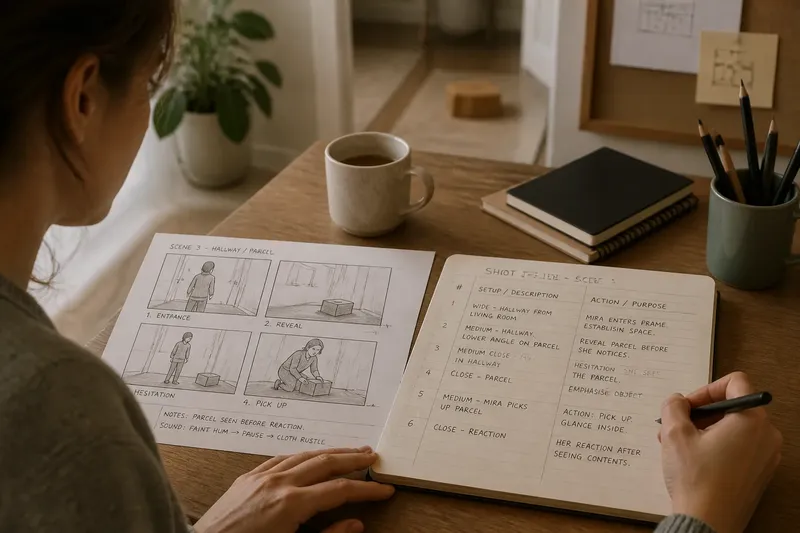
A storyboard or shot list can make a small film easier to shoot, but each solves a different planning problem. A storyboard lets you see how an action might look from one image to the next; a shot list turns that intention into a sequence of camera setups you can actually capture.
The useful choice is not about which format is more professional. It is about what you still need to figure out: the audience’s view of the scene, or the practical order of filming it. Many beginner projects benefit from one tool as the main plan and a small amount of the other where it fills a gap.
A storyboard makes visual ideas visible
A storyboard is a sequence of drawings or reference images showing important moments in a scene. It does not need to look polished. Stick figures, arrows, a floor-plan sketch or frames made from simple shapes can communicate composition, movement and changes in viewpoint.
Its strength is comparison. Put two frames beside each other and you can ask whether the audience will notice a character entering, understand where a sound comes from, or feel that a reaction has enough space. Those questions are harder to answer from a list of shot names alone.
Storyboards are especially helpful when the scene depends on spatial relationships: a character crosses a room, an object changes hands, or someone notices a detail in the background. A quick drawing can reveal that the camera would need to see both the object and the character’s face, or that a doorway blocks the view from the chosen position.
They can also help a solo filmmaker communicate an idea to a friend who is helping with camera or performance. Rather than describe “a close shot, then a wider angle”, you can point to the frame and show where the person is looking and what remains visible.
Keep the drawings loose. If you spend more time refining a face than deciding what the frame needs to show, the storyboard has stopped doing its job.
A shot list turns intention into camera setups
A shot list is written preparation for the shots you plan to record. Entries often include a brief description, framing, camera position, action and any note that will matter on the day. You might write: “Wide from kitchen doorway; Mira enters, puts the blue mug beside the sink; hold until she turns towards the window.”
The list is good at making a shoot legible. It can tell you which shots belong together, what coverage remains, and what you need to remember before changing the camera position. For a small crew, that can be more useful than a page of images if the scene is simple and the main challenge is keeping the session organised.
Written lists are also easier to revise when a location or schedule changes. If the kitchen is unavailable, you can mark the affected shots and decide which action can move to another corner. A storyboard may need redrawing if the new space alters the visual plan substantially.
But a shot list can hide uncertainty behind tidy wording. “Close-up of the mug” says little about whose perspective matters, what is happening around it, or why the audience should see it. Add a short purpose or action to entries that could otherwise be interpreted in several ways.
Choose the tool that answers your current question
Think of the two formats as different kinds of thinking, not rival systems. A storyboard asks, “What will the audience see, and how does that view change?” A shot list asks, “What do we need to record, and how will we keep track of it?”
- Choose a storyboard when blocking, eyelines, screen direction or a visual reveal is still unclear.
- Choose a shot list when the action is understood but you need a practical record of setups and coverage.
- Use both selectively when a few frames carry important visual information and the rest of the scene is straightforward.
- Keep the plan minimal when improvisation is part of the scene and a rigid sequence would get in the way.
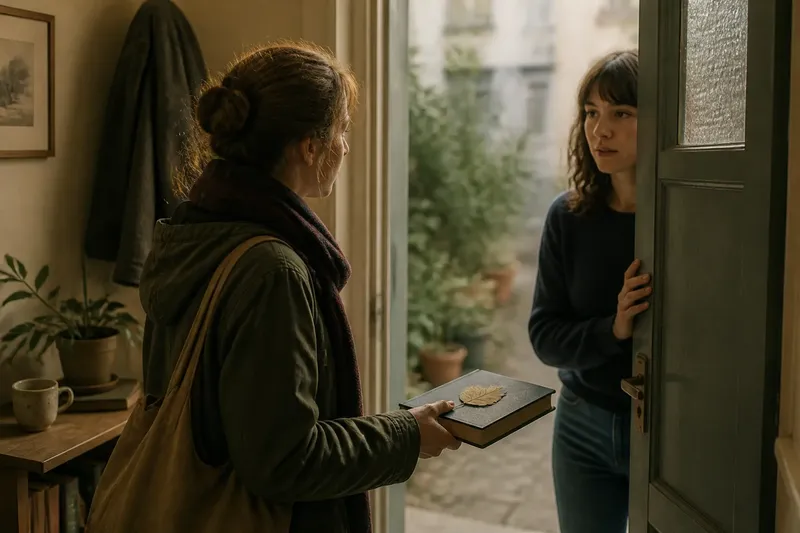
Imagine you are filming a short scene in which a person enters a hallway, sees a parcel on the floor and hesitates before picking it up. If you are unsure whether the parcel should appear before the person’s reaction, sketch the entrance, the reveal and the pause. Once that visual order feels clear, a short shot list can record the doorway view, the parcel detail and the reaction shot, along with any action each needs to include.
The example’s drawings settle a question of audience attention; its written entries help you remember the setups. The expected observable result is a plan that makes the reveal understandable while leaving the shoot’s practical tasks easy to follow.
Make each format specific enough to use
A useful storyboard frame records the information a collaborator or your future self might otherwise have to guess. Include the character’s position, the important object, the direction of movement and, where relevant, a simple camera arrow. Add a note only when the image cannot explain the sound, timing or intention on its own.
For a shot list, use consistent terms that mean something to you. “Wide”, “medium” and “close” can be helpful shorthand, but pair them with the action or purpose. “Medium at table, keep both hands in frame as the envelope opens” is more actionable than “medium shot”.
Separate camera setups from moments in the story. One setup may capture several actions, while one action may require more than one viewpoint. Making that distinction prevents the list from implying that every small movement needs a fresh camera position.
Both tools should leave room for discoveries on location. Note what is essential to preserve, such as the order in which an audience learns a piece of information, and treat less important framing ideas as adaptable. A plan is useful when it helps you make a decision, not when it forbids one.
Combine them without doubling the paperwork
Using both tools does not mean drawing every frame and writing a long entry for every image. Start with the uncertainty that matters most, then add only the second format needed to carry the plan into the shoot.
If a scene has a complicated reveal, make a few storyboard frames for the reveal and its reaction. Below them, list the camera setups needed to record those moments. If the scene is mostly a conversation in one place, a shot list may be enough, with a tiny floor-plan sketch to show where the camera and people sit.
Keep the documents connected. Give storyboard frames simple numbers or names, then use the same labels in the shot list. If the drawing called “Parcel reveal” corresponds to two written setups, the link should be obvious without a separate key or elaborate spreadsheet.
A single page can work well: thumbnail frames on one side, concise setup notes on the other. For a phone-based shoot, a notes app can hold the list while a camera-roll album contains sketches or reference images. Choose a form you can consult quickly, rather than one that looks impressive when printed but disappears under other files.
What should you use for a small shoot?
Can I make a storyboard without drawing well?
Yes. Boxes, arrows, circles and labels can show framing and movement clearly enough for planning. The drawing only needs to distinguish what matters in the shot from what can be ignored.
Is a shot list enough for a short film?
It can be, especially when the action is simple and the main need is to track camera setups. Add a sketch or location diagram if written notes leave uncertainty about where people and objects sit in the frame.
Should every planned shot appear in both formats?
No. Duplicate only the information that needs to travel between visual and practical planning. A key composition may deserve a drawing, while a straightforward insert can be recorded in the list alone.
What if the shoot changes on the day?
Keep the scene’s essential information in mind and revise the plan around the location and available help. Mark what you have captured and update the relevant frame or list entry so you can tell what still needs attention.
Make the plan serve the scene
Before filming, read the plan once as an audience member and once as the person operating the camera. The first pass asks whether the images preserve the scene’s important information; the second asks whether you can tell what to set up and record next.
For storyboard or shot list planning, begin with the question you cannot yet answer. Draw when you need to see the scene’s visual logic, write when you need to organise the work, and combine the two only where each contributes something distinct. Then put the plan within reach and let the location inform the choices that remain open.